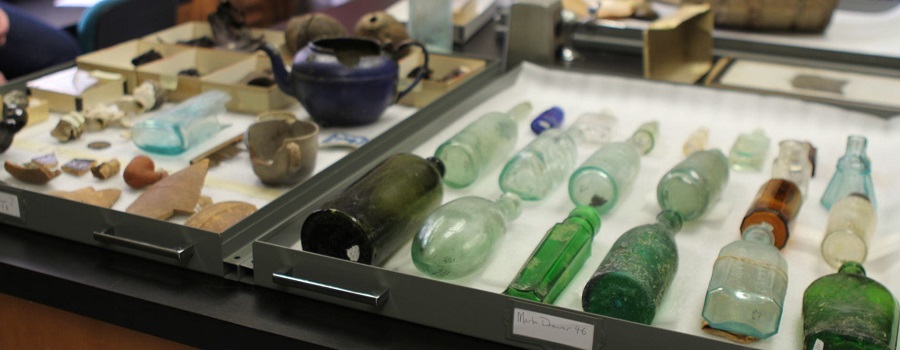
During the 1970s, Georgia State University archaeologists conducted systematic excavations associated with the construction of the Metro Atlanta Rapid Transit Authority (MARTA) rail lines. This project recovered the material remains of Atlanta’s past, and these materials represent the single most comprehensive archaeological collection of Atlanta’s history. In addition, the excavations themselves are among the pioneering projects of urban archaeology in the then nascent field of CRM (Cultural Resource Management). Thus, just the excavation archive, which is part of the collection, is invaluable for the history of archaeology in the US, especially the burgeoning new field of urban archaeology. The entire collection (440 medium-sized “banker” boxes housing over 100,000 artifacts and all the accompanying documentation and excavation archive) has recently been returned to GSU. Showcasing significant “moments” in the life of the city, including several Civil War sites associated with the Battle of Atlanta, the majority of the collection corresponds to the late 19th and early 20th century, the time of Atlanta’s rebirth as a major metropolitan area, the collection opens immense opportunities for faculty and student research and public education and outreach. Furthermore, it will facilitate interdisciplinary collaborations within GSU, as well as with other universities in the Atlanta-area for the curation, conservation, study, and exhibition of the artifacts and archive.
- Creator
-
Jeffrey Glover, Ph.D., GSU Department of Anthropology, and archaeology students
 Georgia State University Library